Student-led · Non-profit · Open knowledge

Food scraps are fuel. Students are leading the change.

FRSH is a free, student-led non-profit that turns household and campus food waste into renewable energy — with practical guides, monitored campus pilots and a community that makes impact measurable.

Join the movement Our story
128,400 kg waste diverted 21,600 kWh energy recovered 47 student chapters Non-profit · open-source · figures are 2026 targets
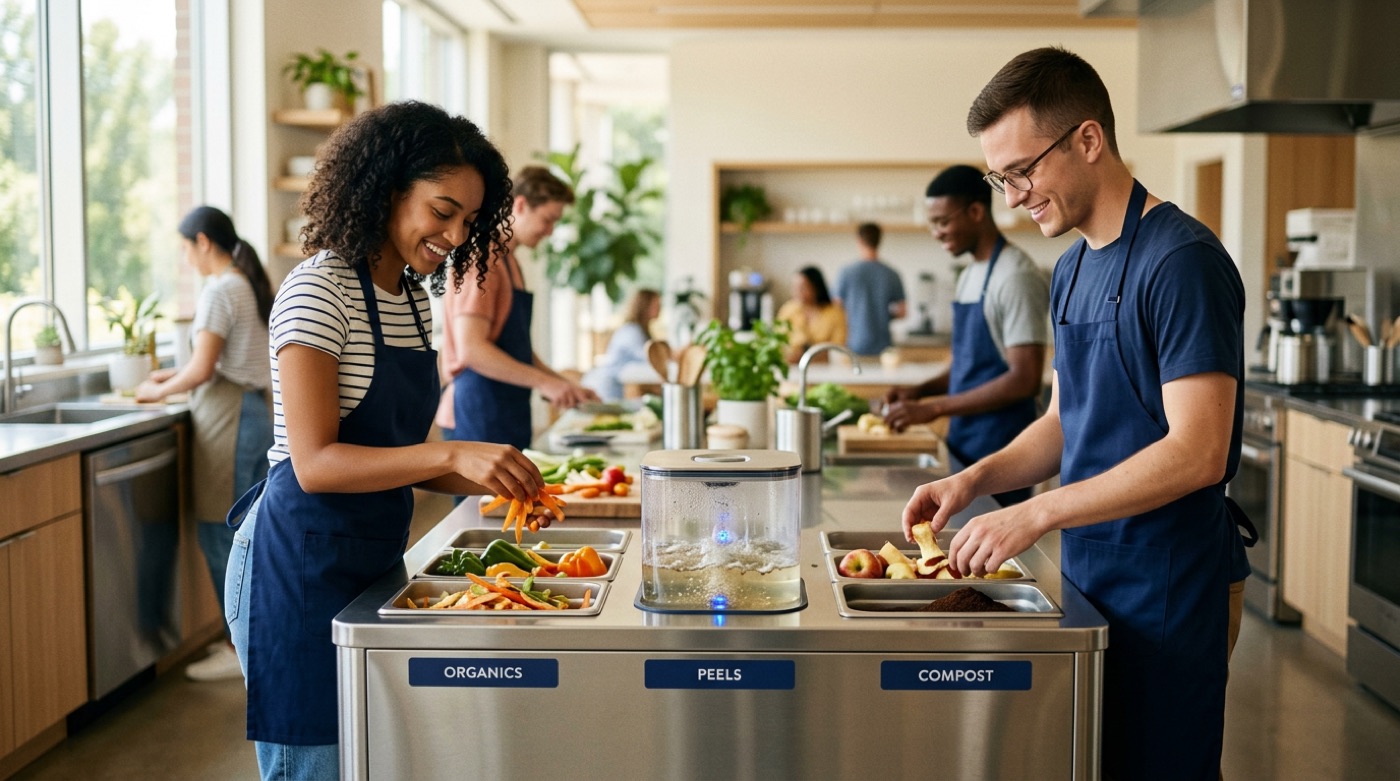
Students in a bright campus kitchen sorting vegetable peels and fruit scraps into a steel collection station fitted with a small clear biodigester
Concept rendering — a campus collection station with a monitored digester trial.
// start here

Three ways into FRSH.

Complete beginner? Start with the science. Bring numbers? Go straight to your kitchen. Ready to act? Take the playbook.

Understand

Learn the science first

Begin with Note 01 — why food waste is really an energy story — then work through anaerobic digestion, explained without jargon.

Open the Learn library
Measure

See your own numbers

Two minutes, no sign-up: the calculator converts your household or dorm's daily scraps into monthly kilowatt-hours.

Run the calculator
Act

Bring FRSH to your school

Chapters run on our open playbook — approval letters, workshop agendas and audit protocols, ready to use.

Talk to a founder
// why we exist

Purpose, mission, direction.

Food waste and energy are two of the biggest problems our generation will inherit — and they are secretly the same problem.

FRSH empowers students and households to turn everyday food waste into renewable energy — through open education, campus pilots and a community that makes impact measurable.
Purpose
To prove that the kitchen — not the power plant — can be where the solution starts.
Vision
A generation that sees food scraps as fuel, not rubbish, where every home and campus kitchen quietly powers itself.
Principles
Non-profit · student-led · open-source knowledge · impact is the only scoreboard.
Pillar 01

Educate

Open, free knowledge: how anaerobic digestion works and how anyone can understand — or build — a home digester.

Pillar 02

Pilot

Real proof at student scale. Campus biodigesters that run in the real world, documented so every school can replicate them.

Pillar 03

Mobilize

Turning knowledge into a movement: members, chapters and measurable collective impact across campuses.

// the 2026 target board

The ambition, by the numbers

2026 target
0
kg waste diverted
2026 target
0
kWh generated
2026 target
0
student chapters
2026 target
0
tonnes CO₂e avoided
Our first-year targets — actual chapter results publish quarterly in our impact notes.
See chapters & the FRSH Score →
// your numbers

What could your kitchen generate?

Slide in your reality. We translate it into watts — free, open, and honest physics.

50
kWh
kWh you could generate per month (estimate)
—
Food waste diverted—
CO₂e avoided—
Equivalent to
  • —phone charges
  • —laptop-hours
  • —LED bulb-hours
  • —kettle boils
  • —EV km
How we calculate
Method: ~0.8 kWh recoverable energy per kg of scraps (biogas heat equivalent) and ~2.1 kg CO₂e avoided per kg diverted from landfill — FRSH's conservative figures from published EPA data. Everyday equivalents use typical appliance use: ~15 Wh per phone charge, ~50 W per laptop, ~10 W per LED bulb, ~0.1 kWh per kettle boil and ~0.15 kWh per EV kilometre. Full sources & method →
// be early

Join the FRSH movement.

Applications are open for members, chapter leads and core-team roles. The form takes about five minutes, and a founder reads every one.

Free forever · student-led · no fees, no fine print